Stephen Barkley
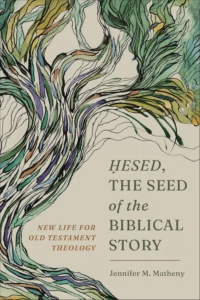 Old Testament theologies have long sought to find one central theme to make sense of the whole Hebrew Bible. Some have suggested kingship or covenant, while others have given up the idea of a unifying centre at all. Walter Brueggemann, for example, focuses on the dialogue between different voices in the Old Testament, each with their own perspective.
Jennifer M. Matheny’s work brings something new to this long search. Rather than propose a centre, she argues that the Hebrew concept of ḥesed functions as a seed from which the various perspectives of the Old Testament grow. This allows for “diversity, relationality, and possibility” within the canon (7).
Ḥesed is a good choice since it occurs in all three major sections of the Hebrew Bible: Torah, Prophets, and Writings. Furthermore, the word itself is rich, beyond what any one English word can represent. Matheny defines ḥesed as:
The loyal loving-kindness that originates in God’s nature, embodying both answerability and possibility through anticipated and creative relational endeavors and expressions among God, humanity, and creation. (23)
Ḥesed, the only word to appear twice in God’s self-declaration (Exodus 34:6–7), is clearly a core element of God’s character. And despite what some have argued, ḥesed is also used to describe humanity’s response to their faithful God. Hosea famously declared that God desires “ḥesed and not sacrifice, the knowledge of God rather than burnt offerings” (NRSV).
I appreciate how Matheny used the order of the Hebrew Bible rather than the English Old Testament to support the flow of her argument. The movement from Torah to Prophets to Writings shows how the ḥesed seed sprouts different trajectories throughout the Hebrew Bible. Her work culminates in a study of the Psalms. It’s telling that ḥesed occurs in every genre of the Psalms, whether praise or lament.
Matheny’s work is academically rigorous yet readable. Don’t be scared away by the transliteration of the Hebrew word ḥesed in the title. This word is still life-giving today! Yahweh’s ḥesed never ceases. They are new every morning. (Lam 3:22–23). Amen!
Matheny, Jennifer M. Ḥesed, the Seed of the Biblical Story: New Life for Old Testament Theology. Baker Academic, 2026.